I finally made it to the Wyoming State Library! Nearly forty-three years of living here in this state, and I've never been there before. (Of
course, I've never been to Yellowstone National Park either. People
travel from all across the world to visit the place. It's in my own
backyard. I could conceivably walk there, but I simply haven't yet
bothered. I've always felt bad about that--but not quite bad enough to
break down and visit.)
Anyway, last autumn, the State Library put out a bulletin that an array of overstocked books was available free to Wyoming's librarians. All we had to do was make some selections and then find a way to retrieve them. I made my selections, but I kept missing my chance to go get them. I wanted to drive down myself but just couldn't cram a trip into my schedule. I also missed a few opportunities for
fellow librarians visiting Cheyenne to haul them back for me. Winter soon arrived, and I abandoned the notion of making the trip until fairer weather cleared the highways. The patient folks at the State Library continued holding onto my books all the while. Well, this past week was Spring Break for us. I finally took the opportunity to drive down to Cheyenne to get my books. In fact I took my family with me. Anyway, I walked into the library, and the receptionist greeted me with a couple of boxes labeled with the name of my school library. Fantastic! But never having visited the State Library before, I wished to have a look around. I hadn't wandered far before a nice lady walked by, glanced my way, and then smiled. It was Chris Van Burgh. I had met her last summer at the Wyoming Library Leadership Institute. She showed us around a bit. Then she asked if I would like some boxes of Zoo Books they were looking to give away for free. She scrambled around to find Danielle Price, along with Thomas Ivie--both fellow graduates from Last summer's Institute--who then loaded me and my kids down with Zoo Books. Truly, it was a heartening visit. Imagine: I walked into a library I had never, ever visited before, and I was greeted by a group of librarians who knew me and welcomed me and my family to their library, the library for all Wyoming's citizens. Indeed, I plan to revisit far more often. My thanks to Chris Van Burgh, Danielle Price, Thomas Ivie, as well as to Abby Beaver and Jessica Dawkins, and to all at the Wyoming State Library. As I stated, I went with the family. We made a day of it. After the State Library, we visited the State Museum (another state facility I had never before entered). We visited Children's Village, part of Cheyenne's Botanical Gardens.Then we drove over to Laramie to visit our college student, working hard in only her second semester at the University. On the road to Laramie, we stopped and saw Russin's Lincoln Head along I-80. A striking sculpture gazing down with a not altogether curious attitude. ( I wish I had not read just that morning a review of the monument that mentioned its odd resemblance to Captain Pike from Star Trek--an image I could not dispel from my mind.)
Those who know of Captain Pike from Star Trek, tell me the comparison is not somehow strangely appropriate.
I look forward to my next trip to Cheyenne and to the Wyoming State Library.
(And to think, my wife wanted to go to Bora Bora for spring break!)
Going over a few pieces from my distant past, comparing and contrasting them to my more recent work, I am pleased at some of the growth evident in much of my writing. My work is now more concise. My language is less flowery. I have dropped a few bad habits and stylistic foibles. For instance, it's apparent I once used a whole lot of he saw, she heard, I think--unnecessary constructions that hamper the focus on the point of view, disconnect the reader from the character, and damage the flow of the narrative. Also, I often fell into the pretentious trap of choosing stilted, seemingly impressive synonyms when a simpler word would have been more appropriate, more effective, more powerful. Contrived plot points, lazy escapes, and shallow characterizations marked much of my prose--and even many of my poems! Indeed, I read back and wonder: How could I have ever written such drivel? Nevertheless, I am thankful. I am thankful that every old piece of writing was--and is--a learning experience. I am thankful to reflect and to recognize growth and to have the opportunity to keep improving. I am thankful that every word helps pave the path of progress. And I am thankful that most of those old pieces were never published! I could "plaster the walls" with rejections slips: scores of standard form rejections from Realms of Fantasy and Asimov's and so forth, along with the periodic encouragements from Van Gelder. Each rejection was a disappointment when I received it. Soon, though, they would all transform into an incitement to do better. Yet, as keenly as I ever wished for my writings to be published, I'm glad now that they weren't. Once a piece is published, that's it. It's finished. The words remain on the page. So now, each and every one of those rejections has come to serve as a preservation from embarrassment. I shudder to think of anyone ever reading my early work as I originally wrote it.
Yet, a handful of those old pieces just might be worth revisiting and revising. If I do end up submitting a few rewritten works, I sure hope I can avoid being thankful ever again for their rejection.
I have read it to be said that most writers work on a small handful of major themes over their careers. A couple few main ideas that they explore, even if through various avenues.
I don't mean writers who rarely venture out of their familiar genres. And I'm sure we could compile an impressive list of eclectic authors whose work runs across a whole host of disparate themes.
Yet, for instance, take Asimov, one of the most prolific, expansive writers I can think of off the top of my head. Was not an overarching theme of much of his work the exploration of intelligence?
Look at Gaiman, a writer who--seems to me, at least--has reached the pinnacle of literary success: the ability to explore any idea in any form and expect it to reach a receptive audience. Perhaps even he might have a limited, though reliable, collection of themes--Curiosity, Loss, Uncertainty, Natural and Supernatural Wonder. I've been writing for a little over a score now. It seems that most of my work--prose, poetry, even journaling--deal with the themes of Dream and Fate and Time. Many of my pieces--early on as well as recent--continue to explore ideas such as fantasy and reality, predestination, memory, expectation, the past and the future and the presence abiding between and beyond. I anticipate delving even further into such realms of wonder with stories and poems I have yet to write. Nevertheless, since studying library science and becoming a school librarian, not only does it appear that much of my work is aimed at younger and younger readers, but it also seems that another theme keeps turning up in my own humble collection: that of information literacy. Again and again, the notion of locating, evaluating, and using information shines brightly through in the pieces I have been developing lately. It's exhilarating--also a wee bit frightening--to consider that I might be expanding my literary horizons.
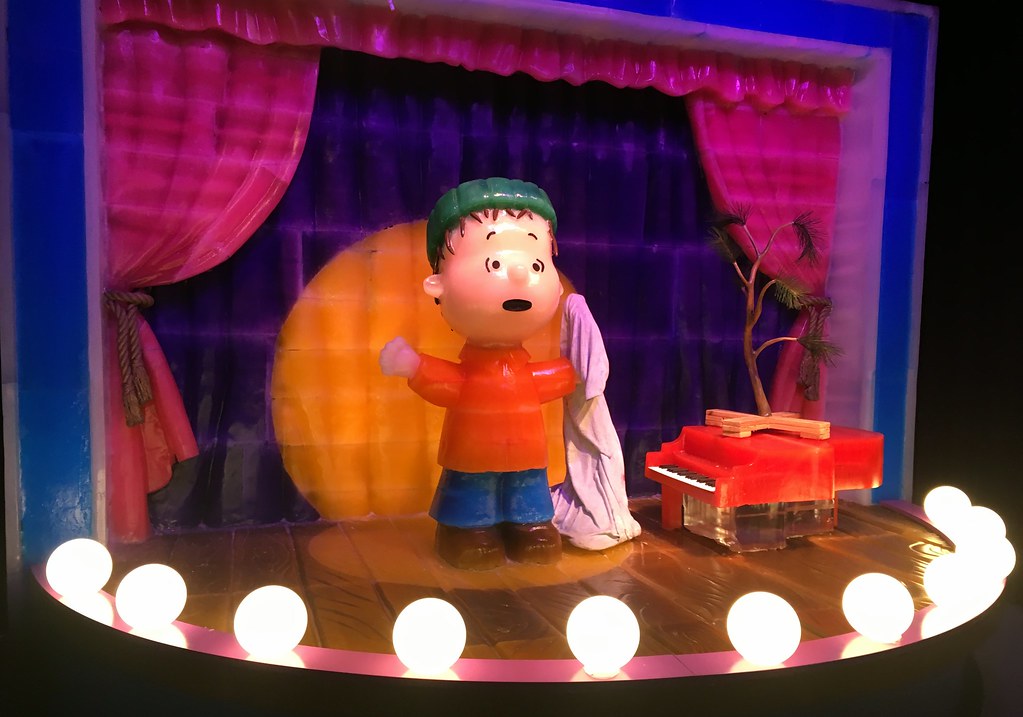
I have found that I cannot read Luke 2:8-14 without hearing the verses in the voice of a little boy, words reverberating through an empty auditorium, speaking such innocent and blessed veneration. Thanks Charles Schulz, Lee Mendelson, Bill Melendez, et. al., and, of course, Chris Shea.
I didn't participate in National Novel Writing Month. I was too busy with the mountain of shorter pieces I've been writing. As of the end of the month, I have 13 pieces going simultaneously. (The month started with even more.) Poems. Short stories. A children's book. Make that two children's books. Every day--even before and after November--I do my best to work on each one, even if just a little bit, no matter what else is happening in my world. It is not the most efficient, nor the most effective method for writing. One might liken it to one of those fevered jugglers who throws beyond a mere set of pins but also tosses in torches, swords, chainsaws, and a couple bawling babies to boot. For those who did participate in NaNoWriMo, I hope the month went well for you. Perhaps I'll join you next year. That is, if I get all these other pieces finished first.
It's Halloween by Jack Prelutsky, illustrated byMarilyn Hafner, was one of my favourite books when I was a child. It remains so even still. I have been sharing its verses with the kids at home--and at school--over the past couple days. They have enjoyed its whimsical, yet frightfully bewitching rhymes, along with the terrifically stylistic pictures, in preparation for this week's tricks and treats. I have enjoyed sharing the the poems and pictures myself, passing down the book in what has become a wonderful tradition. Yet it seems I might have to start a new tradition with a new book. In setting out seasonal texts for display at the school library this month, I happened across a "seldom-circulated, candidate-for-weeding" copy of Halloween by Harry Behn, illustrated by Greg Couch. Originally written in 1949, the verse sets an entrancing tone, with staves populated by some of the elder spirits ever to have reveled upon the night between Summer's end and Winter's beginning. Couch's shadowy illustrations stir a mystical air of motion through every page. The children have been spellbound at every reading. So now, I look forward to sharing both books for years to come, establishing and expanding the Season's traditions in poetic honour of Hallowe'en. It's Halloween Goodreads: https://www.goodreads.com/book/show/203187.It_s_Halloween Halloween Goodreads: https://www.goodreads.com/book/show/698250.Halloween?from_search=true
CC0 1.0 Universal
(CC0 1.0)
Public Domain Dedication